Investing in fair chance hiring to build a more resilient, inclusive, and prosperous Delaware

BY ALONNA BERRY

ACROSS DELAWARE, from the tech hubs in Wilmington to the poultry plants of Sussex County, the refrain from the business community is the same: we need a reliable, skilled workforce to sustain growth. While traditional recruitment channels are often exhausted, a significant pool of talent remains sidelined. As we observe Second Chance Hiring and Fair Chance Month this April, it is time to recognize that economic restoration through employment is not just a social mission; it is a robust workforce solution for the First State.

Beyond the Barrier: Why Second Chances Matter

For the Delaware Center for Justice (DCJ), our work has shown that justice involvement is often a reflection of a person’s past, not a predictor of their professional potential. When employers overlook justice-involved individuals, they lose out on a demographic characterized by high retention rates and deep loyalty.

Research consistently shows that justice-involved employees stay in their jobs longer than those without justice involvement, reducing the high costs associated with turnover. In a tight labor market, these individuals represent a motivated, untapped resource ready to contribute to Delaware’s economic vitality.

The Blueprint for Success

Building a successful fair chance initiative requires more than just “opening the door.” It requires a strategic approach that benefits the individual, the employer, and the community at large. Based on our work with local partners, three key pillars stand out:

Practical Insights for Employers: Success begins with intentionality. We encourage businesses to review their HR policies to remove “blanket bans” on justice-involved applicants. Instead, adopt an individualized assessment that allows companies to find the right person for the right role.

The Power of Wraparound Supports: Retention is strengthened when hiring is paired with support. At DCJ, we see the difference that stable housing, reliable transportation, and mentorship make. When employers partner with community organizations to provide these wraparound services, they create a safety net that allows the employee to focus entirely on job performance and professional growth.

A Culture of Inclusion: Second-chance hiring is most effective when it is woven into a company’s broader efforts. Training frontline managers to lead with empathy and clear expectations ensures that new hires feel valued and integrated into the company culture from day one.

A Stronger Delaware

The benefits of these initiatives extend far beyond the balance sheet. When we provide pathways to gainful employment, we directly reduce recidivism, lower the burden on our legal system, and strengthen the family unit. A working parent is a parent who can provide; a working neighbor is a neighbor who can invest back into the local economy.

As Delaware continues to position itself as a leader in innovation and industry, we cannot afford to leave talent on the sidelines. Investing in fair chance hiring is an investment in a more resilient, inclusive, and prosperous Delaware.

Join the Movement

This April, we challenge Delaware’s business leaders to look at their hiring practices through a new lens. Economic restoration through employment is not a gamble; it is a proven strategy for long-term success. At the Delaware Center for Justice, we stand ready to partner with you to turn these opportunities into reality, ensuring that every Delawarean has the chance to contribute to our state’s bright future.
AN INNOVATIVE TOOL ESTIMATES THE IMPACT OF CLEAN SLATE POLICIES IN EVERY STATe

Here’s what it says about Delaware.

CSI Data Dashboard
By: Dr. Laura Chavez, Director of Research & Data, Clean Slate Initiative

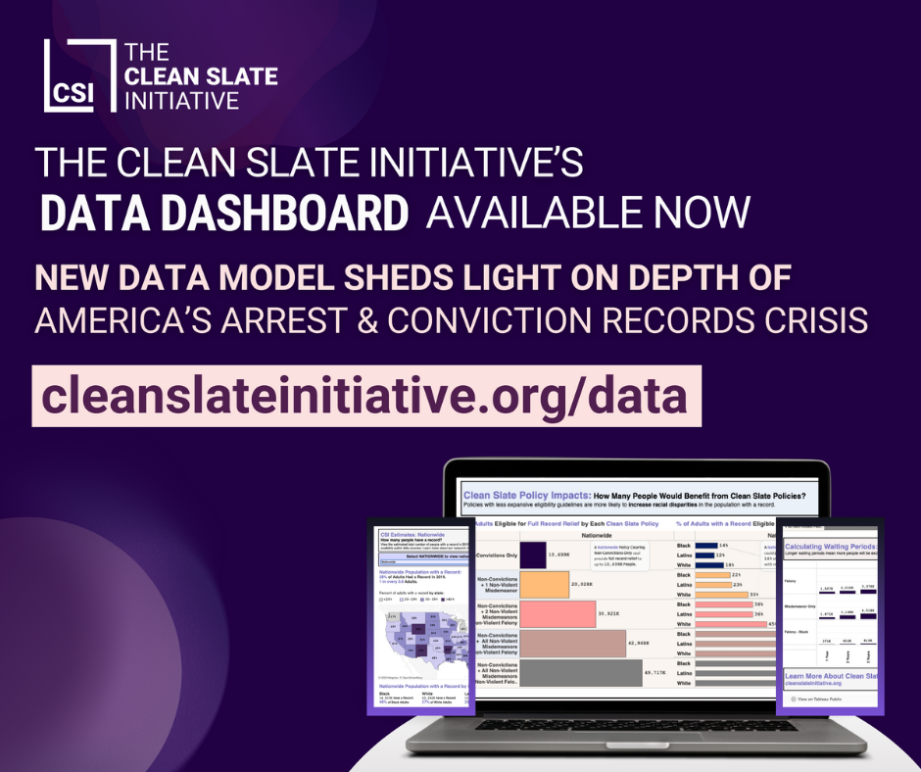
There has always been one big, ironic gap regarding data about arrest and conviction records: a lack of records. Since the beginning of automatic record clearance efforts, advocates, lawmakers, and stakeholders have struggled to gather data that can illustrate policies’ impact. The main problem has been a lack of consistent record-keeping across states — especially data that can be broken down by different demographics. That’s why The Clean Slate Initiative (CSI) is excited to launch our one-of-a-kind data dashboard that provides state-specific data about records and the impacts of record clearance policies. 

Based on our data model’s methodology, we can estimate how many adults in America are impacted by a record, both in states and nationwide. The model is the first of its kind, giving researchers, lawmakers, advocates, and the public the ability to estimate the state-level impacts of Clean Slate laws broken down by race, ethnicity, sex, and types of records. The model uses state and federal data sources and applies recidivism, deportation, mortality, and inter-state mobility rates to ensure our estimates account for dynamic population trends.  

The CSI Data Dashboard is capable of much more than simply producing estimates. Users can examine proposed policies, visualize how waiting periods and eligibility requirements affect the impact, and identify opportunities to reduce existing racial inequities. 

The interactive data dashboard provides visualizations of the scale of people with records in each state broken down by race, ethnicity, sex, and record type. It allows for in-depth analysis of how Clean Slate legislation can reshape the lives of millions, particularly highlighting racial and gender disparities. 

In Delaware, the dashboard highlights the impacts of the Clean Slate legislation that has already passed, assuming the state’s implementation follows a robust interpretation of the law’s criteria. Using our data model to examine Delaware’s Clean Slate legislation: 

  • 61,000 people with a Delaware record will see full record clearance; 
  • 200,000 people in Delaware have an arrest or conviction record, which includes 72,000 Black people (44% of Black adults in the state) and 
  • If Delaware expanded their law to clear all non-conviction records, non-violent misdemeanors, and one (1) non-violent felony, around 118,000 people would benefit from Clean Slate (59% of those with records). 

Our dashboard includes a list of frequently asked questions to aid users. And, our inbox is always open: if you have questions or feedback, don’t hesitate to contact CSI’s Research and Data team at data@cleanslateinitiative.org.   

Data is more than numbers; it can be a blueprint for a better future. By harnessing its power, we equip advocates, lawmakers, and other policy stakeholders with information that can help bring more people a second chance. 

DCJ Welcomes Police Reform Policy & Organizing Coordinator Rob Vanella

After a robust search, the Delaware Center for Justice (DCJ) is excited to announce that Rob Vanella is joining the DCJ team as the organization’s first Police Reform Policy & Organizing Coordinator. A native of Wilmington, Rob is well-known to listeners of the Highlands Bunker podcast and readers of The Delaware Call, of which he is co-founder and serves as Coordinating Editor.

“I feel like I’ve been training my entire life for a role like this,” says Vanella. “I am excited to leverage a broad, diverse network of advocates, activists, and organizers in Delaware as well as the journalism we’ve done over the last five years (and will continue to do) to make a real impact on police reform policy in this legislative session.”

Rob’s position represents a partnership between the Office of Defense Services, the First State’s provider of legal services to indigent and incarcerated clients statewide, and DCJ, a provider of advocacy and services for justice-involved Delawareans since 1920. Rob’s leadership role, new to the social justice ecosystem in Delaware, was created to fill an existing coordination gap within police reform efforts and to support a broad coalition that will advocate for systemic changes to improve relations/trust between Delaware communities and law enforcement. Based out of DCJ, Vanella will have access to the full resources of the Office of Defense Services to meet these challenges head-on as he connects with key stakeholders in the coming weeks.

“Last year, the General Assembly took an important, if imperfect, first step toward meaningful policing reform with the passage of House bills 205 and 206,” says Dave Bever, executive director of DCJ. “We’re delighted to have Rob on board to support and coordinate next steps to guarantee that we don’t lose momentum in this crucial work.”

Visions of Justice Conference: Improving Legislation for the Justice-Impacted Community

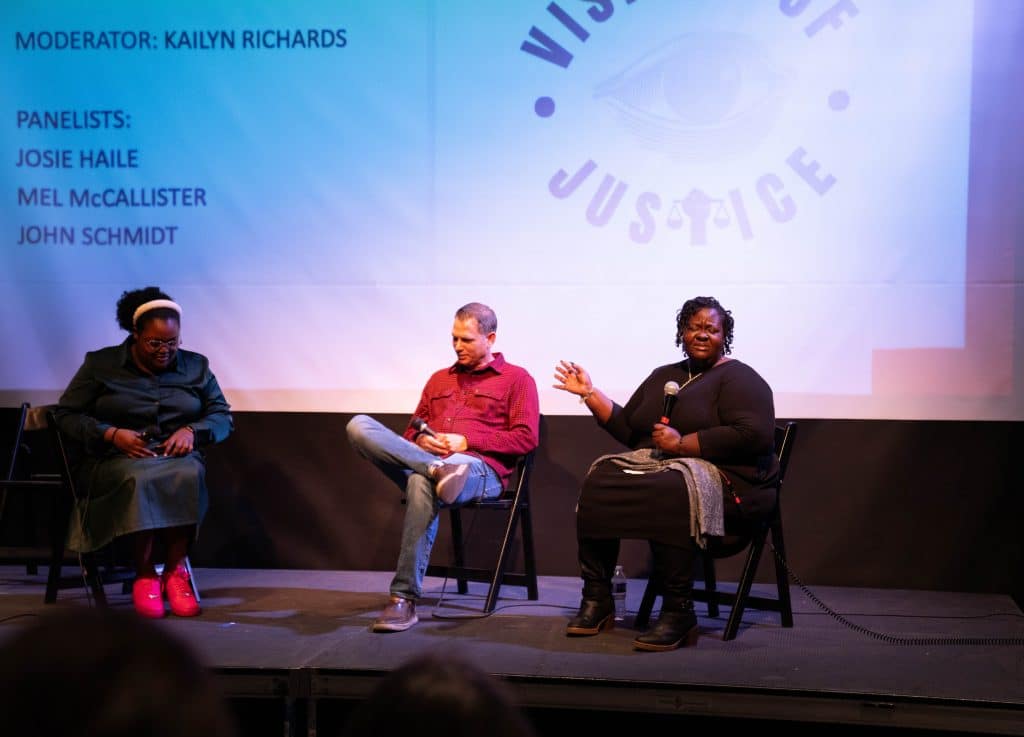
The Visions of Justice Conference held last week brought together over 80 attendees to discuss the struggles that individuals face during reentry to society. The conference featured panelists who shared their personal stories, including Josie Haile and John Schmidt, reminding us all that our lives can change in an instant. Through perseverance and support, it is possible to overcome any obstacles. Participants also experienced a Reentry Simulation that highlighted the challenges faced by individuals trying to reintegrate into society after being incarcerated. The conference also covered important topics such as Clean Slate implementation and the impact on the justice-impacted community.

One of the most powerful experiences for participants was the Reentry Simulation facilitated by the United States Attorney’s Office of Eastern Pennsylvania and PAR-Recycle Works. The simulation demonstrated the challenges that individuals face after being released from incarceration, including difficulties accessing housing, transportation, and employment opportunities. It provided a unique perspective and reinforced the need for more support and resources for individuals during the reentry process.

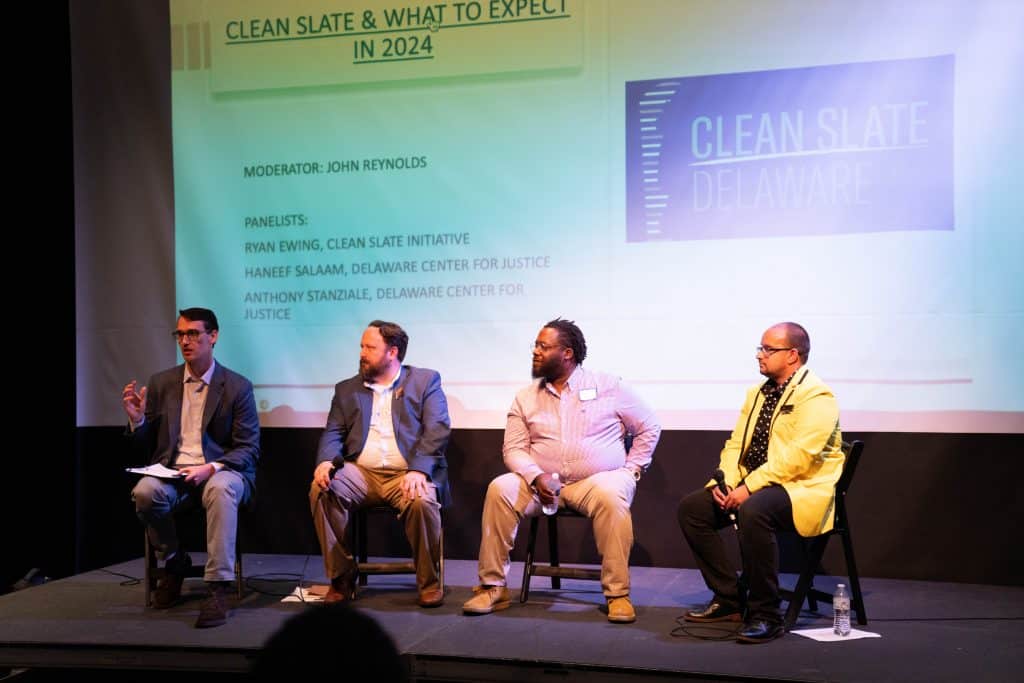
The following panel, moderated by John Reynolds from the ACLU of Delaware, discussed Clean Slate implementation and its positive economic impact on the justice-impacted community. Panelists Ryan Ewing from the Clean Slate Initiative, Haneef Salaam, and Anthony Stanziale from the Delaware Center for Justice provided valuable insights into the challenges faced by individuals with criminal records and the opportunities provided by Clean Slate legislation. Clean Slate is a law that allows for the automatic expungement of certain criminal records, giving individuals a second chance at life through a clean slate, increased job opportunities, and access to housing and educational opportunities.

The conference continued with a keynote address by Dr. Yasser Payne, who focused on the aging incarcerated population. Dr. Payne spoke about the need to provide support and resources for individuals who are serving long-term sentences and the struggles they face as they age. Dr. Payne highlighted the need for more compassionate release programs, prison hospice care, and reentry support for aging individuals returning to society.

The Visions of Justice Conference highlighted the struggles faced by the justice-impacted community and the need for reform in legislation to provide support and resources to those transitioning back to society. The conference demonstrated that through collaboration and perseverance, it is possible to overcome any obstacle. The conference provided valuable insights into the efforts to improve Clean Slate legislation, providing a pathway towards economic stability for those with criminal records. The keynote speaker illustrated the need for more compassionate release programs for aging individuals affected by long-term incarceration.

Visions of Justice Conference allowed legal professionals and activists to come together to share important information and insights on crucial topics. One such highlight was Eliza Hirst’s presentation on the collateral consequences of juvenile records, which left a lasting impact on attendees. The final panel was moderated by DCJ’s Policy Director, Kailyn Richards, and featured a stimulating discussion with New Castle County Executive, Matt Meyer, Misty Seemans, Esq., Office of Defense Services, and Vonderlear Smack, of ALCU of Delaware. This panel brought attention to the sobering statistics of police misconduct and how understanding the new Law Enforcement Officer’s Bill of Rights (LEOBOR) can lead to new legislation that will make law enforcement more accountable and transparent. By bringing together powerful voices in the legal field, Visions of Justice Conference equipped participants with the information to combat injustice.

To learn more about Delaware’s Clean Slate law, find expungement assistance, and other resources, visit Clean Slate Delaware’s automated expungement hub, CleanSlateDE.org.

The Visions of Justice Conference was an essential event bringing together individuals and organizations working for the betterment of the justice-impacted community. The conference highlighted the need for compassionate and supportive legislation and programs to help individuals overcome the obstacles and challenges they face during reentry to society. The conference provided valuable insights into Clean Slate implementation and the positive impact it will have on the justice-impacted community. Through collaboration and continued efforts, we can help individuals overcome the challenges they face and provide a pathway towards a second chance at life.

A first step towards police reform

The Delaware Center for Justice (DCJ) supports HS 1 for House Bill 205 and House Bill 206 as a small first step in the right direction to increasing police transparency and accountability. With that being said, we fully acknowledge that HS 1 for HB 205 and HB 206 do not address all the communities’ concerns about the Law Enforcement Officer Bill of Rights (LEOBOR) and with policing in general, and for that we empathize with the families affected by the shortcomings of this legislation. It was clear after numerous conversations with lawmakers that this legislation has the support needed to pass and therefore, we must focus on moving forward.

To that end, we plan to advocate for a statewide police file retention policy and additional access to records not included in these bills. We will also fight for community appointments to the Council on Police Training (COPT), as well as the establishment of robust Civilian Review Boards (CRBs) to ensure that the community is centered in the response to police misconduct.

We urge members of the General Assembly to view HS 1 for HB 205 and HB 206 as a starting point to police reform, and therefore, the work must not end here. The Delaware Center for Justice looks forward to implementation, analyzing the data, and working with legislators on future police reform efforts.

In solidarity,

Dave Bever

Executive Director

Delaware Center for Justice

Clean Slate Delaware Hosts CSI, Advocates, and Directly Impacted Leaders at State Capitol for Second Chance Month Lobby Day

Delaware’s Clean Slate Act will take effect in August 2024, but for people living with a record in Delaware, that implementation can’t come soon enough. That’s why Clean Slate DE held its first Lobby Day on April 4, 2023, to educate lawmakers on the necessary reforms to make the 2024 implementation successful, accessible, and equitable.

Community advocates, directly impacted leaders, and Clean Slate DE partners, including the ACLU of Delaware, Delaware Center for Justice, and the Clean Slate Initiative, met with state legislators at Legislative Hall in Dover. We’re incredibly proud of the work these dedicated individuals did in bringing our key campaign issues to lawmakers’ attention. Advocates held group meetings with state senators and representatives regarding two campaign priorities: the successful implementation of the state’s automated record sealing law and ensuring all cases that do not include a conviction are eligible for automated expungement.  

Successful implementation means eliminating the barriers that fines and fees present to the expungement process. Despite being among the first states to pass Clean Slate legislation, we’re the only “Clean Slate” state that limits eligibility for record clearance due to outstanding fines and fees. Living with a record can make financial barriers hard to overcome. Fines and fees related to a person’s record often go unpaid because people cannot access stable employment, housing, and opportunities for advancement due to their record. 

Allowing individuals to clear their records regardless of what they owe is a common-sense solution to increase financial stability for Delawareans and help people pay their outstanding fines and fees. Delaware’s reputation as the “First State” should motivate us to set a forward-thinking example: bringing Delaware in line with known best practices will encourage all future states to tackle fines and fees when passing initial Clean Slate laws.

Lobbying groups also addressed the issue of non-conviction records. A substantial number of people with records in Delaware have records for non-convictions only, which means after their arrest, the person was either never charged or never convicted of a crime in that case — but they’re still saddled with the consequences of a record. A Delaware non-conviction record, just like a conviction record, remains publicly available and will appear on background checks unless it is expunged. 

All cases that do not include a conviction should be eligible for the automated expungement process, including Delawareans serving a period of incarceration, probation, or parole. Currently, no one on probation or parole is eligible for any form of expungement, including for separate cases that did not result in a conviction. People should never be punished for cases decided in their favor, and records that never led to a conviction shouldn’t hinder anyone’s livelihood. 

Over the course of the day, 45 advocates met with over 20 legislators seeking their commitment to support and act on these priorities. In addition to being prepped with pre-lobby training and talking point resources, many of the directly impacted advocates had received prior storytelling training. This enabled them to effectively communicate their experiences in the most impactful way possible when speaking to legislators.

The lobby day was received well by legislators across both parties, energizing advocates and lawmakers to work together toward a successful Clean Slate implementation in 2024. 

Clean Slate efforts don’t end at the passage of the initial legislation, and that’s why this lobbying event was so important. The campaign and community must continue to engage legislators to navigate the complicated implementation process and ensure the law has its intended impact. Records are a substantial barrier to many life-sustaining goals, like finding a place to live and a good job. We must work together to ensure that Clean Slate’s implementation is as smooth as possible for the Delawareans who need that relief — and paves a path for other states to successfully implement their own Clean Slate policies.